
Last month I hopped on a call with an IT director at a recently acquired aged care provider.
He told me his biggest regret: when they ran the numbers on the acquisition, they counted beds and assets—but never counted the cost of system integration.
Three sites. Four separate systems for rostering, care documentation, medication management, and family communication.
Creating one staff account meant doing it four times across four systems.
Twelve hours a week spent manually reconciling data across systems.
Not that the systems were bad.
They just did not talk to each other.
This is Lesson 3 from our five lessons building aged care software, in practice:
Connected systems beat more systems. If data does not flow, neither does your care.
The Hidden Cost Acquisitions Miss
Acquisition models often price property, beds, workforce, and brand. They rarely price:
- Duplicate identity and staff provisioning across applications
- Manual re-entry of resident demographics, admissions, and discharges
- Roster-to-task handoffs that live in spreadsheets
- Care delivery recorded in one system and reported in another
- Family updates assembled by hand from clinical and operational notes
Those costs do not appear as a line item called "integration debt." They appear as overtime, delayed billing, inconsistent reporting, and staff who become the middleware between systems.
The provider in that call did not need four better products. They needed the existing products to share a few high-volume data flows.
Don't Start With a Big-Bang Overhaul
When integration pain becomes visible, the common instinct is replacement:
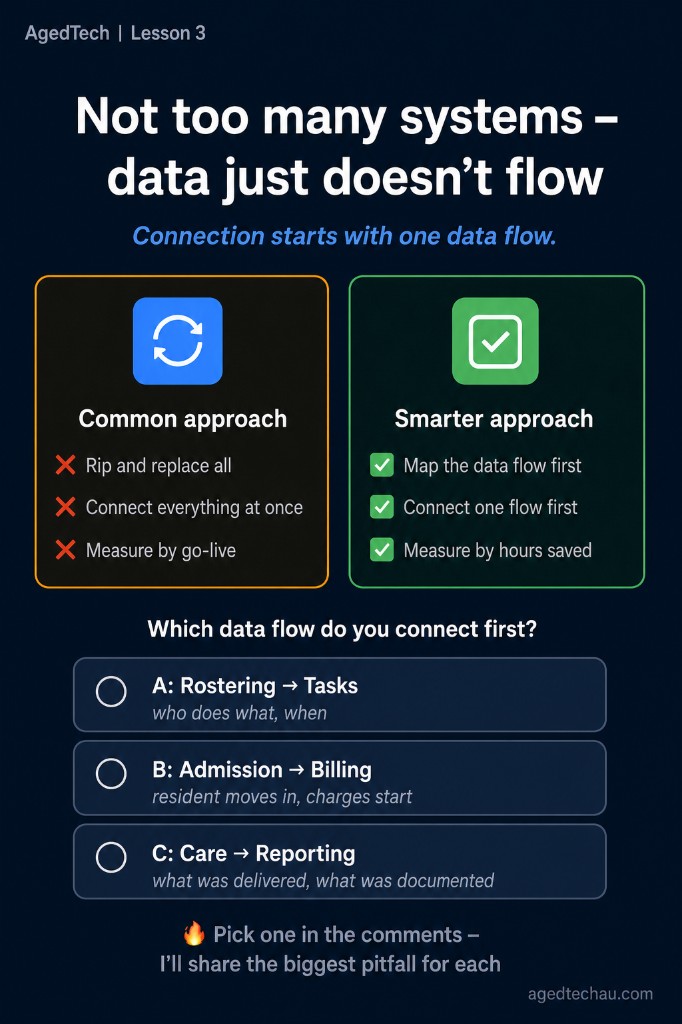
- Rip and replace everything
- Connect every system in one programme
- Measure success by go-live date
That approach looks decisive. In multi-site aged care, it often creates a longer outage of trust—new tools, unfinished mappings, and the same re-entry work moved into a different UI.
A smarter approach:
- Map your data flows first — who re-enters what, where, and how often
- Pick the single most re-entered data point — and connect that one first
- Don't replace systems — add a thin integration layer on top
- Measure success by hours saved for staff, not by "system went live"
Integration is not a one-off project. It is one data flow at a time.
Connect it. Save an hour. Move to the next.
What "Map the Data Flow" Actually Means
Before choosing middleware or rewriting interfaces, walk one operational journey end to end.
For each handoff, capture:
- The source system of truth
- The destination system that needs the same fact
- Who currently copies or reconciles it
- How often it happens (per admission, per shift, per week)
- What breaks when the copy is late or wrong
- Which identifier links the resident, staff member, or facility across systems
You are not looking for every possible interface. You are looking for the highest-friction re-entry points—the places where people are already paying the integration tax.
Our technical overview of CMS, identity, and quality integration covers architecture patterns once you know which flow to connect first.
Three Data Flows Providers Often Connect First
A. Rostering → Tasks
What it connects: who is rostered, to which tasks or shifts, and when.
Why it matters: Task allocation, handover, and accountability depend on knowing who is on duty. When rostering and task systems diverge, coordinators re-key names, roles, and times—or leave gaps that only appear mid-shift.
Biggest pitfall: Connecting names without reliable staff identity, facility, and role context. A roster sync that creates duplicate workers or wrong unit assignments creates more cleanup than it removes.
B. Admission → Billing
What it connects: resident moves in, charges start.
Why it matters: Admission triggers demographics, packages, room or service allocation, and billing readiness. Manual gaps here delay revenue, create credit-note work, and leave finance and care teams arguing over different versions of the same resident event.
Biggest pitfall: Treating billing as a finance-only interface. If admission status, leave dates, and service changes are not governed as operational events, billing inherits stale or incomplete clinical/admin data.
C. Care → Family Reporting
What it connects: what was delivered and documented, to what families are told.
Why it matters: Family communication loses trust when updates are assembled manually from notes that live elsewhere. Staff spend time rewriting care activity into portals or emails instead of delivering care.
Biggest pitfall: Pushing raw clinical detail without consent, role, and summary rules. Connection without an information-governance layer can overshare, undershare, or create another manual editing step before release.
How to Choose Your First Flow
Use a simple filter:
| Question | Prefer the flow that... | | --- | --- | | Volume | Happens many times per week across sites | | Pain | Creates visible re-entry or reconciliation work today | | Ownership | Has a clear source system and destination owner | | Risk | Failure causes delay, rework, or audit friction—not only inconvenience | | Scope | Can ship as one thin interface without replacing platforms |
Then define success in operational terms: hours saved, duplicate entry removed, exception rate reduced—not solely that an API was switched on.
The Takeaway
Providers rarely suffer from owning too much software in the abstract.
They suffer when software cannot share the facts that operations already depend on.
If you are facing integration challenges:
- Map the re-entry first
- Connect one flow
- Keep the systems that work
- Add a thin integration layer
- Measure by staff hours returned to care and coordination
Which data flow would you connect first?
- A. Rostering → Tasks
- B. Admission → Billing
- C. Care → Family Reporting
Frequently Asked Questions
Should aged care providers replace systems to fix integration?
Usually not as the first move. If core systems work operationally, a thin integration layer that removes the highest-volume re-entry often delivers value faster—and with less disruption—than a rip-and-replace programme.
What is a "thin integration layer"?
A focused interface—API, event sync, or governed connector—that moves specific fields between systems of record without forcing every application onto one platform. It should have clear ownership, retry handling, and auditability.
How do acquisitions underestimate integration cost?
Deal models often count beds, assets, and headcount, but miss duplicate provisioning, manual reconciliation, reporting lag, and the ongoing staff time required to keep disconnected systems aligned after day one.
How should success be measured?
Measure hours saved, reduced re-entry, fewer billing or roster exceptions, and faster exception resolution. Go-live alone does not prove that data is flowing usefully through operations.
Which data flow should we start with?
Start with the flow that staff re-enter most often and that already has a clear source and destination. For many providers that is rostering to tasks, admission to billing, or care activity to family reporting—but the right first flow is the one your teams pay for every week.
Related Reading
- 5 Lessons From 5+ Years Building Aged Care Software
- Integrating Aged Care Systems: CMS, Identity, and Quality
- Support at Home: Better Care Decisions Start With Better Data Quality
- SSO in Multi-Site Aged Care: Access Control and Compliance
- NQIP Data Collection: Why Quality Managers Spend Weeks Moving Data
Discuss your highest-friction data flows and integration priorities—or explore how AgedTech AU helps providers build connected systems one flow at a time.