
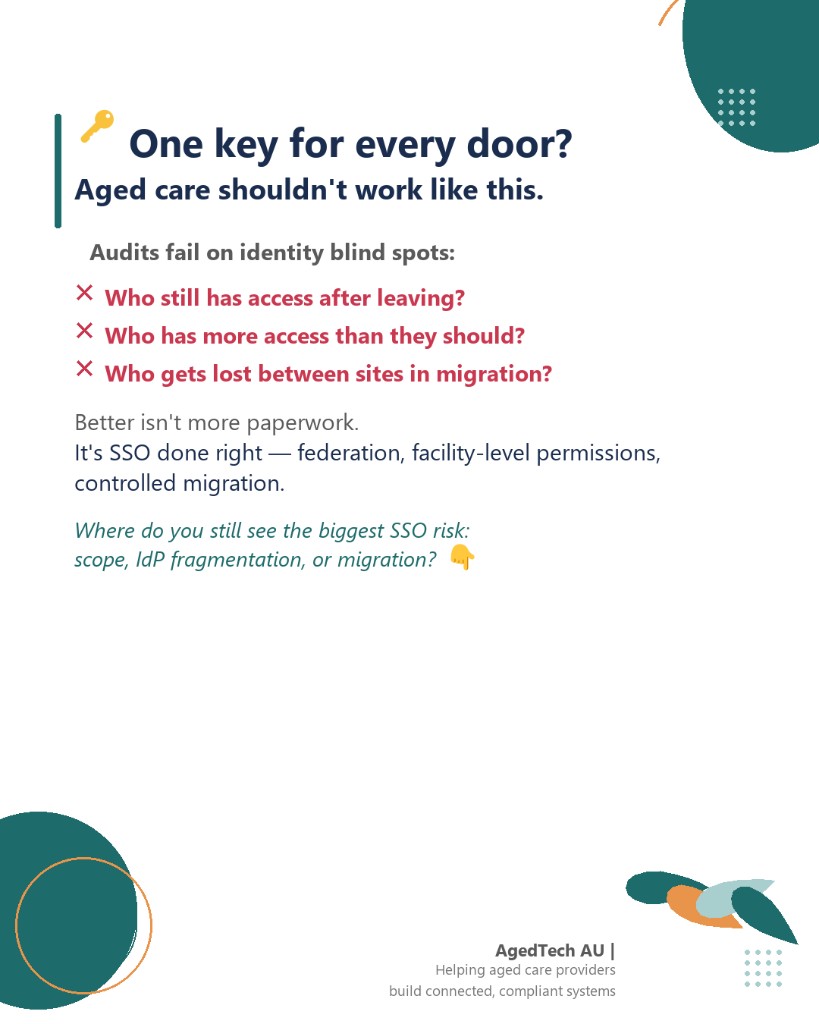
In aged care, SSO is not just "fewer passwords."
It is access control and compliance.
Most providers operate across multiple sites. Staff need the right access for the right facility—not an organisation-wide master key. When SSO is treated as a convenience feature instead of a governance control, the login experience improves while the risk profile stays the same—or gets worse.
Why Multi-Site Aged Care Changes the Identity Problem
A single-site clinic can often live with broad roles and local password policies. Multi-site aged care cannot.
Care workers, agency staff, clinical leads, quality managers, and corporate teams move across facilities, services, and systems. Many also need different permissions for:
- Residential homes vs home-care services
- Clinical documentation vs quality reporting
- Local operational access vs group-level oversight
- Temporary coverage vs permanent assignment
If authentication succeeds but authorisation is blunt, the organisation has not solved identity. It has only shortened the login path to over-privileged access.
The compliance implication is direct: who could see which resident records, when, and under what role assignment must be defensible. Convenience without facility-level control does not meet that bar.
The Real SSO Failure Mode: "Redirect and Done"
Many SSO projects stop at federation plumbing:
- Configure SAML or OpenID Connect
- Redirect login to the identity provider
- Map a few claim fields
- Mark the project complete
That can reduce password reset tickets. It does not automatically fix:
- Over-privileged access — organisation-wide roles used because facility mapping was deferred
- Ghost accounts — leavers still active in one system after IdP disablement elsewhere
- Inconsistent policy — MFA, session lifetime, and password rules differ by app and IdP
- Audit gaps — incomplete joiners/movers/leavers evidence across local and federated paths
Better is not more paperwork. Better is federation designed with facility-level permissions and a controlled migration plan.
Risk 1: Scope — Organisation-Wide Keys in a Facility World
The first design question is not "which protocol?" It is "what is the unit of access?"
In multi-site aged care, the practical unit is usually facility (or service), combined with role and sometimes unit or programme scope.
Common failure patterns:
- A nurse covering one home inherits access to every home in the group
- Corporate quality roles receive write access where read-only would suffice
- Agency accounts are cloned from permanent templates with excess entitlements
- "Admin" is used as a shortcut during go-live and never narrowed
Facility-level permission design should answer:
- Which facilities can this identity enter?
- What can they do in each facility?
- How are temporary assignments granted and expired?
- Who approves cross-site elevation?
- How is access reviewed when roster location changes?
Without those answers, SSO becomes a faster way to reach the wrong data.
Risk 2: IdP Fragmentation Across Azure AD, Okta, and Other Providers
Identity in aged care groups rarely sits in one place. Acquisitions, regional IT estates, and SaaS preferences leave providers spanning:
- Microsoft Entra ID (Azure AD)
- Okta
- Other enterprise IdPs
- Application-local accounts still used for exceptions, contractors, or legacy modules
Fragmentation creates operational and audit complexity:
- The same person may exist under different identifiers
- Disablement in one IdP does not guarantee revocation everywhere
- Claim schemas differ, so facility and role mapping becomes inconsistent
- Security policy (MFA, conditional access, device trust) is not uniformly enforced
Federation helps only when applications can trust a clear identity contract: stable subject identifiers, facility claims or group mappings, role claims, and reliable lifecycle events.
For broader architecture context, see integrating aged care systems across CMS, identity, and quality platforms.
Risk 3: Migration — Where Local and Federated Logins Coexist
Cutover is where audit gaps appear.
During migration, providers often run dual modes:
- Existing local usernames and passwords
- New federated SSO for cohorts that have been mapped
- Temporary break-glass accounts for support and emergency access
That coexistence is normal. Uncontrolled coexistence is risky.
Typical cutover failures:
- Users authenticated by SSO while old local accounts remain active and unmonitored
- Incomplete mapping leaves shared or generic accounts in place
- Support teams recreate local passwords "just for today" and never reverse them
- Leavers are disabled in the IdP but still valid in application-local stores
- Access reviews cover federated users only, missing residual local accounts
A controlled migration treats dual-mode operation as a governed phase with:
- Explicit cohort waves (by facility, role, or IdP source)
- Account matching and conflict resolution before cutover
- Local authentication disablement once a cohort is stable
- Exception register for break-glass and contractor paths
- Joiners/movers/leavers reconciliation across IdP and application
- Audit evidence for who could authenticate by which method on which date
If migration governance is weak, SSO can increase the number of valid paths into the system without improving control.
What Good Looks Like
A mature multi-site aged care SSO programme usually includes:
- [ ] Federation with enterprise IdPs (Entra ID, Okta, or equivalent) using OIDC/SAML
- [ ] Facility-scoped authorisation—not organisation-wide defaults
- [ ] Clear mapping from IdP groups/claims to application roles and facility entitlements
- [ ] Joiner, mover, and leaver processes that revoke access across all entry paths
- [ ] Controlled dual-mode cutover with a dated plan to retire local passwords
- [ ] Break-glass accounts that are few, monitored, and regularly reviewed
- [ ] Audit logs that show identity source, facility scope, role, and session context
- [ ] Periodic access certification for privileged and cross-site roles
This is identity as governance infrastructure—not a UX upgrade alone.
A Practical Self-Check for Providers
Ask your technology and risk teams:
- Can a user with one home assignment open records at another home today?
- If Entra ID or Okta disables an account, which application-local paths still work?
- During the last SSO cutover, how long did local and federated logins coexist—and who tracked residual accounts?
- Do access reviews include facility scope, or only application role names?
- Can you evidence MFA and authentication method consistently across clinical, quality, and portal systems?
If those answers are unclear, the biggest issue is probably not password count. It is control design.
Where the Biggest Risk Usually Sits
In multi-site aged care, the three recurring SSO risk areas are:
- Scope — permissions too broad for facility reality
- IdP fragmentation — multiple identity sources without a single lifecycle truth
- Migration — dual-mode cutover that leaves audit and access gaps
Different organisations feel different pressure points. Groups mid-acquisition often struggle most with IdP fragmentation. Providers rushing go-live often under-design facility scope. Programmes that "finish" at redirect commonly leave migration debt behind.
The durable answer is the same across all three: treat SSO as access control and compliance architecture—federation, facility-level permissions, and controlled migration—rather than a login convenience project.
Frequently Asked Questions
Is SSO enough to meet aged care access-control expectations?
No. SSO authenticates identity; authorisation still has to enforce facility, role, and lifecycle controls. Without those, SSO can improve convenience while leaving over-privileged access in place.
Why do multi-site providers need facility-level permissions?
Staff often work across some sites but not all. Organisation-wide access creates unnecessary exposure to resident and operational data and weakens audit defensibility when access must be justified by role and location.
What goes wrong when Azure AD and Okta both exist in one group?
Duplicate identities, inconsistent claim mapping, uneven MFA policy, and incomplete offboarding are common. Applications need a clear federation contract and a process that reconciles lifecycle events across every IdP in use.
Why is dual-mode cutover a compliance risk?
While local passwords and federated logins coexist, there are multiple valid entry paths. If residual local accounts are not tracked and retired, leavers or shared accounts can remain active outside IdP controls.
What should aged care SSO projects prioritise first?
Start with facility-scoped access design and joiner/mover/leaver flows, then implement federation and a phased migration. Protocol configuration alone does not reduce the highest operational risks.
Related Reading
- Integrating Aged Care Systems: CMS, Identity, and Quality
- Enterprise Aged Care Software Buyer's Guide 2026
- Most Aged Care Providers Don't Have a Compliance Problem—They Have a Systems Problem
- 5 Lessons From 5+ Years Building Aged Care Software
Discuss multi-site SSO, federation, and facility-level access design for your aged care platforms—or explore how AgedTech AU helps providers build connected, compliant systems.