
Support at Home is changing more than funding models.
It is changing how important data quality is across aged care operations.
As providers prepare for a more consumer-directed, service-based model, the organisations that will adapt well are not simply those with stronger compliance folders. They are the ones whose information is connected, accurate at the point of capture, and visible when teams need to make decisions.
The Same Lesson, A New Urgency
Earlier in our Quality Management Series, we shared one lesson that keeps surfacing in real operational environments:
Audit findings only create value when they drive measurable improvements.
Support at Home reinforces the same principle at a broader scale: better care decisions depend on better information.
That is not a technology slogan. It is an operational reality.
When funding, service delivery, and accountability shift toward individualised support packages, providers need reliable data across care planning, service delivery, billing, quality reporting, and continuous improvement—not reconciled manually at quarter-end.
The Challenge Is Not More Data
Australian aged care providers already collect substantial information: clinical records, incident reports, quality indicators, survey feedback, audit findings, rostering data, and financial records.
The harder problem is trust and usability.
For aged care providers, the challenge is not simply collecting more data. It is making sure information is:
- Connected across systems — resident, service, and facility context travels with the record
- Accurate at the point of capture — validated, standardised entry at the source, not corrected weeks later in Excel
- Visible when teams need to make decisions — managers, clinicians, and quality leaders see the same timely picture
When any one of these breaks down, governance weakens—even if individual teams are working hard.
Current Challenges vs Future-Ready Systems
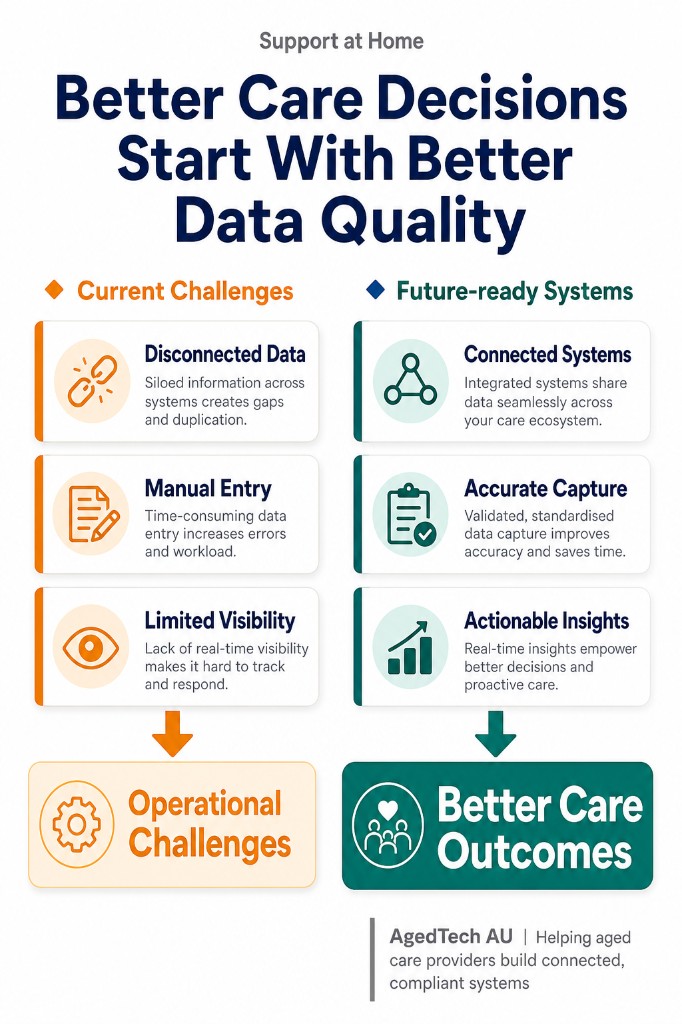
The gap between today's friction and tomorrow's capability is familiar to most quality and operations leaders.
Where Many Providers Are Today
Disconnected data
Siloed information across CMS platforms, clinical systems, finance, quality software, and spreadsheets creates gaps, duplication, and conflicting versions of the same resident or service episode.
Manual entry
Time-consuming re-keying between systems increases errors, absorbs staff capacity, and turns skilled coordinators into data clerks.
Limited visibility
Without real-time or near-real-time views, leaders struggle to track service delivery, identify emerging risk, or respond before small issues become reportable events.
The cumulative result is not a compliance failure on paper—it is operational drag: teams working around systems instead of through them.
What Future-Ready Systems Enable
Connected systems
Integrated platforms share data across the care ecosystem—resident identity, service plans, delivery notes, incidents, and quality workflows linked by common identifiers and governed data contracts. See integrating aged care systems for practical architecture patterns.
Accurate capture
Validated, standardised data entry at the point of care—dropdowns, mandatory fields, cross-checks, and role-based permissions—reduces the reconciliation burden that still defines NQIP collection for many providers.
Actionable insights
Dashboards and exception views turn raw records into decisions: which services are under-delivered, where complaints cluster, which units show incident trends, and whether PCI improvement actions are changing outcomes.
The destination is straightforward: better care outcomes, supported by information teams can actually use.
What Disconnected Systems Cost in Practice
When systems do not share reliable context, teams often spend valuable time on work that adds no clinical value:
- Re-entering information — the same resident details, service codes, or care notes typed into multiple platforms
- Validating records — chasing discrepancies between clinical, billing, and quality exports before submission deadlines
- Preparing reports manually — assembling evidence packs from email threads, shared drives, and standalone registers
That effort displaces the work Support at Home will demand more of: continuous improvement, proactive care coordination, and evidence-based service design.
Providers stuck in manual reconciliation mode will feel the shift acutely—not because regulations become impossible, but because the operating model requires faster, more granular decisions than spreadsheet governance can support.
Support at Home Raises the Bar on Operational Data
Support at Home is often discussed in terms of funding streams and consumer choice. For technology and quality leaders, the deeper implication is operational traceability.
Individualised packages mean providers must demonstrate:
- What services were planned and authorised
- What was actually delivered, when, and by whom
- How changes in care needs were identified and responded to
- How quality, risk, and feedback signals informed service adjustments
That is a data quality problem dressed as a policy change.
If service delivery records cannot connect to incident data, clinical notes, and feedback channels, leaders cannot answer basic governance questions without manual investigation.
Conversely, when operational data is connected and trustworthy, compliance becomes a by-product of daily work—not a separate project that starts six weeks before a deadline.
Three Data Quality Priorities for Providers Preparing for Support at Home
1. Establish a Single Resident and Service Identity
Duplicate or mismatched records across CMS, rostering, finance, and quality platforms are the root cause of most reconciliation pain. Before adding new modules, confirm how resident, package, and service identifiers flow between systems—and where breaks occur today.
2. Reduce Manual Handoffs at the Point of Capture
Every time data leaves one system as a CSV and re-enters another by hand, accuracy degrades. Prioritise validated capture in operational tools and automated sync for high-volume fields: demographics, service codes, delivery timestamps, and status changes.
3. Build Visibility for Decision-Makers, Not Only Auditors
Reporting designed solely for external submission produces lagging indicators. Quality and operations teams need exception views—clusters, trends, and open actions—so audit findings and incident patterns trigger improvement before the next board pack is assembled.
From Compliance Processes to Everyday Governance
The future of aged care will require more than compliance processes.
It will require connected systems that help providers capture better data, improve visibility, and support better decisions every day.
That aligns with what we have seen across the sector: high-performing organisations do not treat governance as seasonal audit preparation. They embed evidence, accountability, and improvement into how care is delivered and recorded.
At AgedTech AU, we believe technology should make compliance part of everyday operations—not an additional workload.
Software that strengthens governance does not add more forms. It connects the forms, signals, and workflows that already exist so teams spend less time chasing information and more time improving care.
Quick Self-Assessment
Where does your organisation sit today?
- Future-ready — Resident and service data flows across care, quality, and finance systems with minimal manual reconciliation; leaders use live views for operational decisions
- Improving — Key integrations exist, but quality reporting and service delivery still require significant manual validation
- Fragmented — Teams re-enter data across multiple platforms; reporting depends on spreadsheets and email
- Uncertain — Data volume is high, but no one can demonstrate a single trusted view of service delivery and quality for one resident last month
If you answered 3 or 4, Support at Home will expose the gap faster than incremental policy tweaks can paper over it. The fix is not a bigger compliance team—it is better-connected operational data.
Frequently Asked Questions
How does Support at Home affect data quality requirements for aged care providers?
Support at Home shifts toward individualised service packages and greater consumer direction. Providers must track planned versus delivered services, care changes, and outcomes with more granularity. That requires connected, accurate operational data—not only end-of-period reporting.
What is the difference between collecting more data and improving data quality?
Collecting more data adds volume. Improving data quality means information is connected across systems, captured accurately at the source, and visible when teams need to act. Without those three qualities, additional data often increases reconciliation work without improving decisions.
Why do aged care teams spend so much time re-entering information?
Most aged care technology estates grew through acquisitions, regional variation, and best-of-breed tools that were never designed to share context. When systems lack reliable integration, staff become the data transport layer—copying records between clinical, finance, quality, and reporting platforms.
Can providers improve data quality without replacing their CMS?
Often yes. Integration architecture—APIs, event sync, reconciled resident and facility mapping, and governed data contracts—can connect existing CMS, clinical, rostering, and quality platforms. See integrating aged care systems. The goal is trusted, connected data—not necessarily a single monolithic replacement.
How does data quality relate to audit findings and continuous improvement?
Audit findings only drive improvement when they connect to owned actions, evidence, and measurable outcomes. Disconnected data makes that loop fragile: findings sit in one register, incidents in another, and PCI trackers in a third. Connected quality systems close the loop from signal to action.
Related Reading
- Most Aged Care Providers Don't Have a Compliance Problem—They Have a Systems Problem
- Connecting Feedback to Operational Data in Aged Care
- NQIP Data Collection: Why Quality Managers Spend Weeks Moving Data
- Integrating Aged Care Systems: CMS, Identity, and Quality
- PCI and Continuous Improvement in Quality Management
- Enterprise Aged Care Software Buyer's Guide 2026
Discuss data quality and system integration for your aged care operations—or explore how connected quality platforms can support better care decisions at AgedTech AU.