
In our five lessons from building aged care software, Lesson 1 was straightforward:
Compliance only becomes sustainable when embedded into everyday operations.
If staff have to "do compliance" as a separate task, it will always be rushed, skipped, or forgotten. That is not a culture problem first—it is a design problem.
Here is what embedding compliance looks like in practice.
Why Separate Compliance Tasks Fail
Aged care teams already carry a full operational load: clinical notes, handovers, medication rounds, incidents, family communication, and care planning.
When mandatory items sit outside that work—in a second system, a shared checklist, or a quarterly form pack—compliance becomes competing work. Under pressure, competing work loses.
The pattern is familiar:
- Clinical documentation in one system
- Mandatory reviews in another
- Policy acknowledgments completed independently at every site
- Head office reconciling answers after the fact
Each extra step is another chance to forget—and another place where evidence becomes inconsistent.
The fix is not more reminders. It is redesigning the workflow so that completing the real job also completes the compliance requirement.
Example 1: Mandatory Reviews Inside the Clinical Note
One provider's clinical team completed nursing notes in one system, then manually checked a separate compliance list to confirm mandatory items had been addressed—falls risk, skin integrity, behavioural symptoms, advance care planning.
Two steps. Two systems. Two chances to forget.
We embedded those compliance triggers directly into the clinical note template. When a nurse documents a note, the mandatory review items appear in the same flow—not in a separate checklist.
No extra login. No separate task. Just the flow of good clinical documentation.
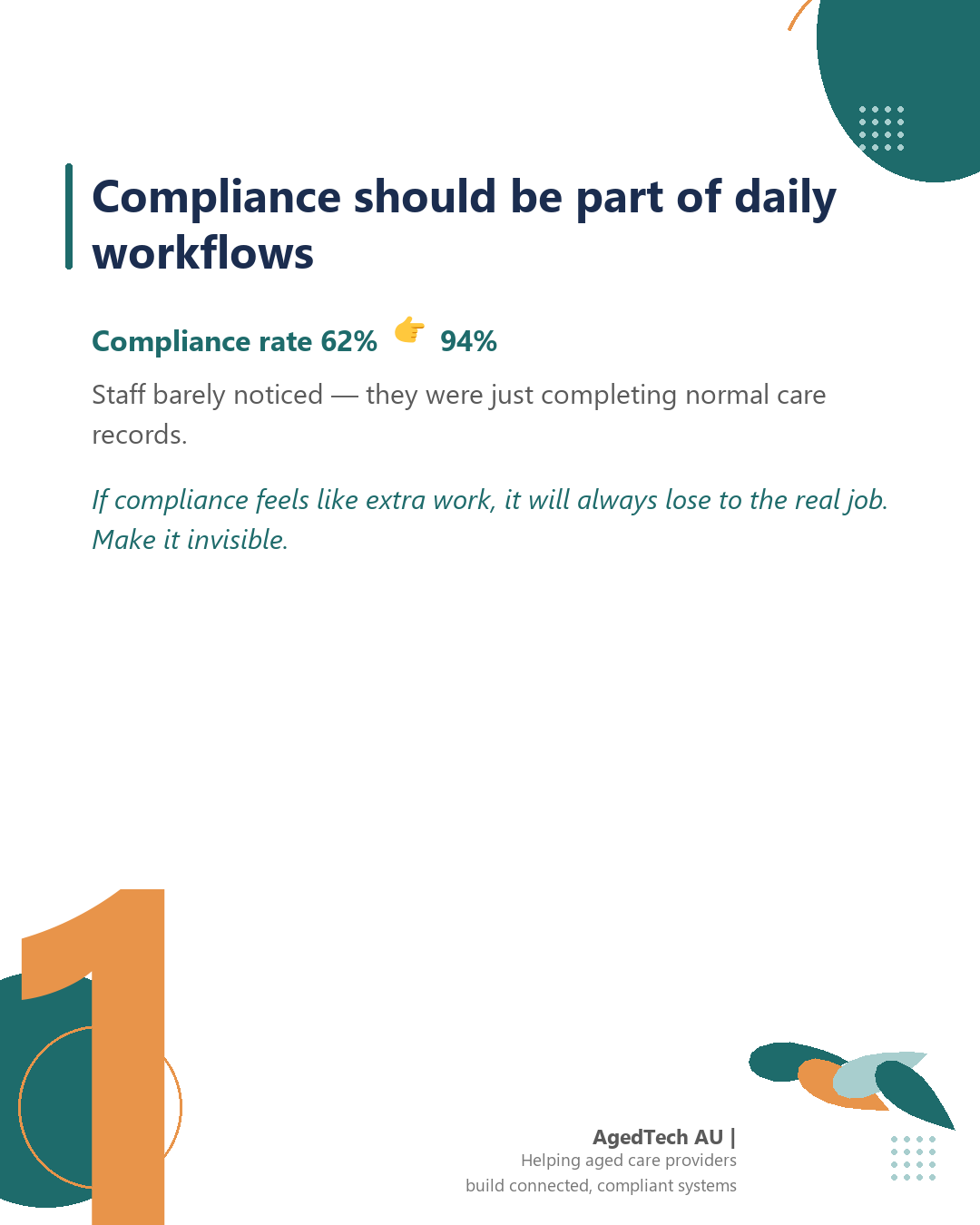
Result: compliance completion rates moved from 62% to 94% within one quarter. Staff barely noticed the change—they were just doing their notes.
That outcome matters because it shows the constraint was not motivation. The previous process asked people to remember a second workflow after finishing the first. Embedding the requirement removed the memory tax.
Design Principles From This Change
- Put mandatory prompts where the work already happens
- Prefer guided templates over standalone checklists
- Capture evidence as part of the clinical record, not a parallel register
- Measure completion from the operational system, not from chasing emails
This is the difference between asking staff to prove compliance and designing systems where compliance is a by-product of care documentation.
Example 2: One Policy Acknowledgment for the Whole Group
We also worked with a provider that had three services under the same group. Every quarter, each service independently completed the same policy acknowledgment forms.
Three sites. Three sets of answers. Three different interpretations of the same policy.
Head office spent days reconciling discrepancies before audit reporting could begin.
We centralised the process. The acknowledgment is now completed once—by a single designated service on behalf of the group. The result syncs automatically across all services under the same group. Other services can view the final outcome but cannot modify the answers. Reporting pulls directly from that single source of truth.
Result: no duplicate work, no inconsistent answers, and audit compliance reports generated in minutes instead of days.
Why Centralisation Matters Here
Not every compliance activity should be local. Where the policy, interpretation, and evidence should be consistent across a group, independent site completion creates artificial variation.
A stronger model:
- Designate ownership for group-level acknowledgments
- Complete the form once against the current policy version
- Sync the outcome to every service in scope
- Allow read-only visibility for local teams
- Generate audit reports from the shared record
That approach reduces administrative load and strengthens governance at the same time. Auditors and quality leaders see one answer, with clear ownership—not three conflicting versions.
The Takeaway
Whether it is clinical documentation or policy acknowledgments, compliance should not feel like a separate job.
- Embed required checks into workflows staff already complete
- Centralise what should be consistent across services
- Remove friction wherever an extra login, form, or reconciliation step exists
If compliance feels like extra work, it will always lose to the real job. Make it invisible—staff do their work, and compliance happens along the way.
A practical test for any provider:
If we stopped sending reminders tomorrow, would this process still be completed?
If the answer is no, the requirement is still sitting outside the workflow.
How to Apply This in Your Organisation
Start with one high-friction compliance process and map it end to end:
- Where is the operational work already happening?
- Where does the compliance step sit today—same system, second system, spreadsheet, or email?
- What causes incompleteness: forgotten steps, duplicate entry, or conflicting local answers?
- Can the mandatory item be prompted inside the primary workflow?
- Should the activity be completed once for the group, or locally for each service?
- How will completion and evidence be reported without manual reconciliation?
For many providers, the highest-return opportunities are clinical templates, incident workflows, policy acknowledgments, and audit action follow-up—areas where separate checklists still sit beside the real work.
This also aligns with broader governance design: systems problems often masquerade as compliance problems. The durable fix is operational design, not seasonal chase-down.
Frequently Asked Questions
What does "embedded compliance" mean in aged care?
It means mandatory checks, evidence, and acknowledgments are completed as part of everyday operational workflows—clinical notes, incident handling, policy review—rather than as separate tasks after the fact.
Does embedding compliance mean adding more mandatory fields?
Not necessarily. Poorly designed mandatory fields can increase workarounds. Effective design places the right prompts in the existing flow, keeps language operational, and captures evidence without forcing staff into a second system.
When should policy acknowledgments be centralised across services?
When the same policy applies group-wide and inconsistent local answers create reconciliation work without adding local clinical value. Designate one owner, sync the outcome, and keep local visibility read-only where appropriate.
How quickly can completion rates improve after workflow redesign?
In the clinical note example above, completion moved from 62% to 94% within one quarter. Results vary by process, but removing separate steps often produces faster gains than reminder campaigns alone.
How does this relate to audit readiness?
Embedded and centralised processes create a clearer evidence trail. Reports can pull from the operational source of truth instead of reconstructing compliance from emails, local copies, and end-of-quarter reconciliation.
Related Reading
- 5 Lessons From 5+ Years Building Aged Care Software
- Most Aged Care Providers Don't Have a Compliance Problem—They Have a Systems Problem
- Internal Audit Tools for Aged Care Quality Programmes
- PCI and Continuous Improvement in Quality Management
- Integrating Aged Care Systems: CMS, Identity, and Quality
Discuss embedding compliance into your clinical and policy workflows—or explore how AgedTech AU helps providers build connected, compliant systems.